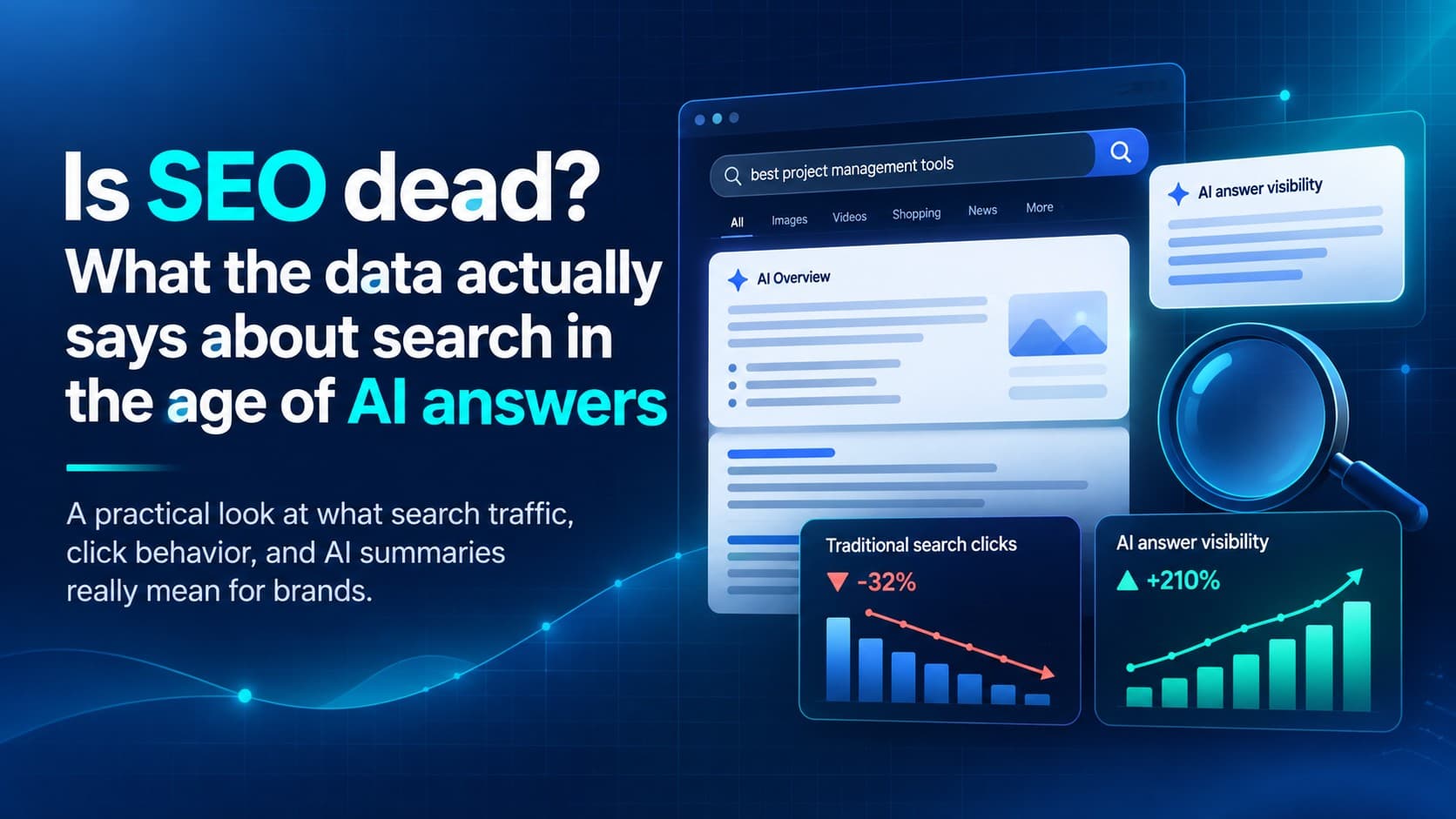
For twenty-five years, search worked the same way. You typed a query, got ten blue links, and clicked one. Search engine optimization grew up around that page: rank higher, get the click. Now Google answers many questions itself with AI Overviews, and a growing share of people ask ChatGPT, Perplexity, Gemini or Copilot instead of searching at all. The obvious question is whether SEO still matters.
Short answer: it matters more, but for a different reason. Every AI search tool builds its answer from pages it can find and trust, and it finds them the same way search engines always have. What has changed is what you get for it. Ranking used to earn a click. Increasingly, it earns a citation, and a citation only sometimes turns into a visit. Below are the numbers, checked against their sources, and what they mean for a store.
What has actually changed: the numbers
There is a lot of confident noise about this. These are the figures that hold up, with where each one comes from.
- Most Google searches now end without a click. In 2024, 58.5% of US and 59.7% of EU Google searches ended with no click to any website (SparkToro and Datos, 2024). SparkToro's 2026 update puts the US figure at 68% for January to April 2026, with only 276 of every 1,000 searches reaching the open web (SparkToro, 2026). The two studies use different data panels, so read them as the same direction rather than a precise trend line.
- AI Overviews reach more people than any other AI product. Google said at I/O in May 2026 that AI Overviews have more than 2.5 billion monthly users. In Pew's analysis of real browsing, 60% of question-style searches showed an AI summary in March 2025 (Pew Research Center).
- When an AI Overview appears, people click less. Pew found users clicked a normal result on 8% of visits that showed an AI summary, against 15% without one, and clicked a link inside the summary on just 1% of visits. Ahrefs measured a 34.5% drop in clicks to the top result in 2025, then 58% in its February 2026 update (Ahrefs, 2025; Ahrefs, 2026). Seer Interactive saw organic click-through fall 61% on informational queries that carried an Overview (Seer Interactive, 2025).
- Being cited inside the answer helps. In the same Seer study, brands cited within an AI Overview earned 35% more organic clicks and 91% more paid clicks than brands that were not. That is the new prize: not only ranking below the answer, but being named in it.
Two cautions before anyone panics. These studies lean heavily on informational queries, the "how does X work" kind, which AI answers well. Searches where someone wants to buy, book or compare specific products behave differently, because the person still has to go somewhere to do it. And zero-click does not mean the searcher went away unhappy; often the answer was on the page.
How AI search finds its answers
A common assumption is that AI tools answer from memory. For anything current, they do not. They look it up first, read what they find, and write an answer from it, usually with links to the sources. The technical name is retrieval-augmented generation. In practice it looks like this:
- Retrieve. The tool searches an index of the web for pages relevant to the question.
- Read. It pulls the relevant passages from the pages it found, and weighs how credible each source looks.
- Answer. It writes a response from those passages and cites the pages it used.
Step one is plain search. If a page is not in the index, or the crawler is not allowed to fetch it, it never reaches step two. Google is explicit about this for its own AI features:
There are no additional requirements to appear in AI Overviews or AI Mode, nor other special optimizations necessary. … To be eligible to be shown as a supporting link in AI Overviews or AI Mode, a page must be indexed and eligible to be shown in Google Search with a snippet.
That is from Google's own guidance on AI features and your website, which also says there is no special structured data or "AI text file" you need to add. ChatGPT's search draws on third-party search providers, Bing among them, plus OpenAI's own crawler, so being indexed in Bing matters as much as being in Google. Perplexity runs its own crawler. None of these can cite what they cannot find.
What the research says gets you cited
The most cited study on this is GEO: Generative Engine Optimization (Aggarwal et al., KDD 2024), by researchers at Princeton and IIT Delhi. They rewrote web pages in different ways and measured how much of an AI engine's answer each version earned. The changes that helped most:
- Adding quotations from credible sources: about 43% more visibility in their test engine, and 22% more when they re-ran it on Perplexity.
- Adding specific statistics: about 33% more.
- Writing more fluently: about 29% more.
- Citing sources: about 28% more.
- Keyword stuffing: about 9% worse. The oldest trick in SEO actively hurts here.
Treat these as direction, not a formula. The study was a controlled benchmark, rewriting one page against a fixed set of competitors in a simulated engine, not a measurement of real Google or ChatGPT traffic, and the authors note the results vary by subject. What it does show clearly is what these systems reward: pages that make specific, attributed, checkable claims.
Where AI use is growing
Microsoft publishes a quarterly measure of the share of people aged 15 to 64 who used any generative AI product. Its Q2 2026 figures:
- United Arab Emirates: 73.3%
- Singapore: 64.3%
- France: 49.6%
- United Kingdom: 43.7%
- Canada: 38.5%
- United States: 33.0%
- India: 18.5%, close to the global average of 18.8%. That counts individuals; businesses tell a different story. In Deloitte's 2026 survey, 40% of Indian enterprise leaders reported significant or full use of AI, against about 28% globally (Deloitte).
One caution: this measures AI use in general, not AI search. Search is where the exposure is highest, because AI Overviews reach people who never open a chatbot. In the UK, 53% of adults say they often see AI summaries in search results (Ofcom). For a store selling into the US and Canada, the practical reading is that a third or more of your customers already use these tools, and most of the rest see AI answers every time they search.
What to change on your store
None of this needs a new platform or a special "AI SEO" package. It needs the fundamentals done properly, plus a few habits that suit how these systems read.
1. Make sure the right crawlers can reach you
Many stores block AI bots wholesale, often by accident through a security app or a copied robots.txt, and in doing so drop out of AI search entirely. The companies separate crawling for training from crawling for search, so you can decide each one separately:
- OpenAI: OAI-SearchBot decides whether you appear in ChatGPT search. GPTBot is for model training. ChatGPT-User fetches a page when a user asks. Blocking GPTBot does not remove you from ChatGPT search; blocking OAI-SearchBot does (OpenAI).
- Anthropic: Claude-SearchBot for search, ClaudeBot for training, Claude-User for user requests (Anthropic).
- Perplexity: PerplexityBot surfaces sites in Perplexity answers and, Perplexity says, is not used to train models (Perplexity).
- Google: AI Overviews and AI Mode use ordinary Googlebot. Google-Extended only controls whether your content is used for Gemini training and grounding, and Google says it does not affect Search (Google). Blocking Google-Extended will not keep you out of AI Overviews, and allowing it will not get you in.
Then check you are actually indexed: Google Search Console for Google, and Bing Webmaster Tools for Bing, which also feeds ChatGPT and Copilot. Bing supports IndexNow, which lets you tell it the moment a page changes.
2. Answer first, then prove it
Put the direct answer in the first sentence or two under each heading, then the evidence. Use specific numbers from your own business where you can: your real delivery times, return rate, sizing data, or what a product is made of and where. Attribute claims, quote people who know, and link to where facts come from. That is exactly what the research above found these systems reward, and it is also simply better writing for customers.
3. Structure pages so a passage stands on its own
AI tools lift passages, not whole pages. Clear, descriptive headings, short sections that make sense out of context, real lists for steps and features, and a comparison written out plainly all make your content easier to quote correctly. On product pages, the same idea means structured facts in proper fields, not buried in a paragraph. We covered that in detail in our guide to preparing a Shopify catalog for AI agents.
4. Build the reputation the AI checks
When someone asks an assistant for the best store for something, it leans on what other sites say about you: reviews, directories, forums, press. Keep your name, what you sell and your policies consistent everywhere, earn genuine reviews on the platforms your customers use, and take part honestly where your buyers talk. One caution: Wikipedia strongly discourages people from writing about their own company (Wikipedia's conflict-of-interest guideline), so do not try to shortcut it.
5. Put effort where clicks still happen
AI answers absorb the simple questions first. Searches with commercial intent, where someone wants to buy, compare specific products, check stock or book, still end on a website, and increasingly in an agent's checkout. For a store, that means product and collection pages, accurate shopping feeds, and being ready for agent checkout matter more than a steady stream of generic how-to articles.
6. Measure it honestly
There are now better tools for this than there were a year ago, and one real blind spot.
- Search Console shows whether you appear in AI answers. Its Generative AI performance report, added in 2026, counts how often links to your site were shown in AI Overviews and AI Mode, by page, country and device. It shows impressions only, not clicks or the questions asked (Google).
- Bing shows how often Copilot cites you. Bing Webmaster Tools' AI Performance report, in public preview since February 2026, counts citations of your pages in Copilot and Bing's AI summaries, and shows which pages were cited (Microsoft). It does not cover ChatGPT.
- Google Analytics now separates assistant traffic. GA4 has a built-in AI Assistant channel for visitors arriving from ChatGPT, Gemini, DeepSeek, Copilot and Grok. Google's definition does not list Perplexity, whose visits still land under Referral, and any visit that arrives without a referrer, from an app for example, still shows as Direct (Google).
- The blind spot is Google's own AI features. The same channel explicitly excludes AI Overviews and AI Mode, and clicks from them arrive as ordinary Google organic traffic. There is no clean way to separate them. A text-fragment trick circulates for this, but it also matches featured snippets and was never reliable, so be wary of any report that claims precise AI Overview click numbers.
Beyond the dashboards, the most useful measure is simple: ask the assistants the questions your customers ask, every month, and write down whether you appear and what they say.
What not to do
- Do not buy an "AI schema" package. Google says plainly there is no special structured data for its AI features. Normal, accurate schema is worth having; magic schema does not exist.
- Do not treat llms.txt as a ranking lever. Google says you do not need AI text files. We publish one ourselves because it is cheap and harmless, but there is no evidence it changes whether you get cited.
- Do not keyword-stuff. In the one controlled study we have, it made pages less visible.
- Do not block every AI bot to stop training if you still want to appear in AI search. Block the training crawlers and allow the search ones.
- Do not abandon SEO. Every AI search tool starts with an index. Falling out of it is the one way to be certain you will never be cited.
The verdict
SEO is not dying. The job has changed. It used to be about winning the click. Now it is about being findable, being trusted, and being the page an answer is built from, whether or not the searcher ever visits. The stores that do well are the ones with clear, accurate, specific information that is easy to find and easy to quote, which is what good SEO always was underneath the tricks.
If you want to see where you stand, our step-by-step guide to checking what ChatGPT, Copilot and Perplexity say about your store walks through the audit. We also keep a longer AI search visibility checklist in our guides, free on request. For help doing the work, see AI search visibility and SEO and growth, or book a free consultation.