01
Shopify ↔ Dynamics 365
Items, stock, orders, and customers between Shopify and Business Central or F&O — posting profiles and tax groups mapped so finance trusts the numbers.
Shopify to ERP to CRM — orders, inventory, and customers moving on rails you can see. Built with retries, idempotency keys, and alerts, because an integration's failure mode is silence.
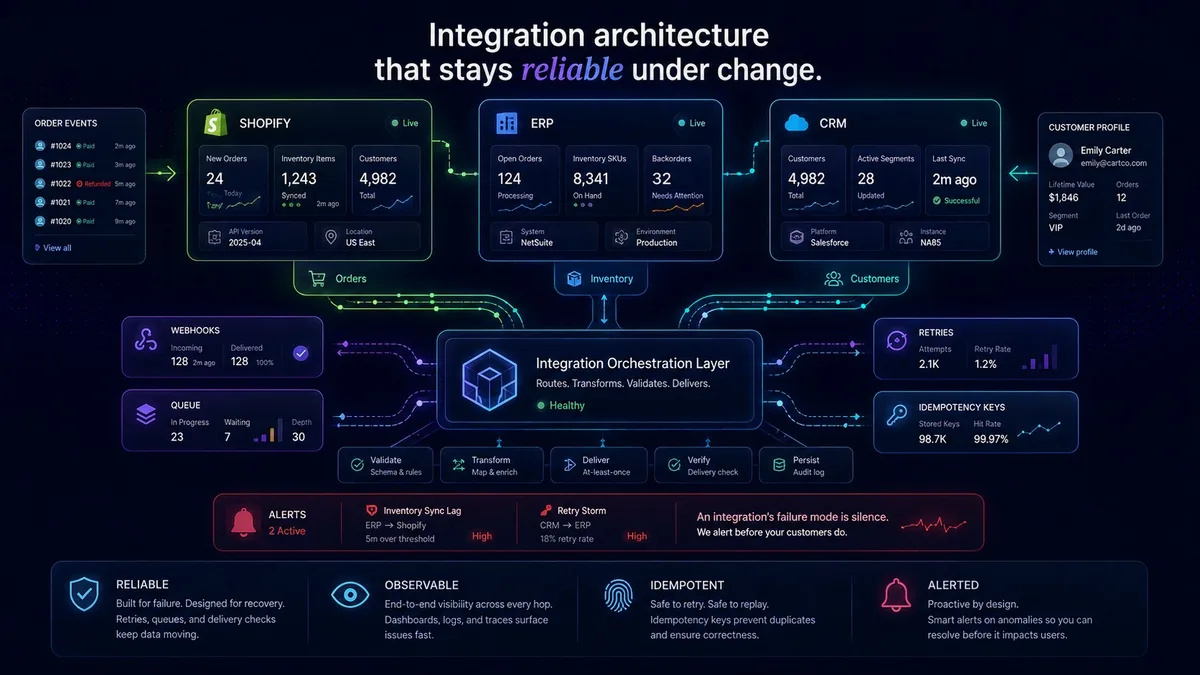
Items, stock, orders, and customers between Shopify and Business Central or F&O — posting profiles and tax groups mapped so finance trusts the numbers.
Orders and customers into Sales or Marketing Cloud, lifecycle signals back to the store — with field mapping agreed up front, not discovered in production.
Orders, fulfillments, tracking numbers, and cancellations kept consistent — including the awkward cases: partials, exchanges, address edits after payment.
Stock and product data on a visible schedule with drift detection, so overselling is caught in minutes instead of at pick time.
Moneris and Stripe wiring — like the dues and event payments we built for the Chiropractic Association of Canada — with settlements matched back to orders.
Queue depth and failure dashboards, alerts that reach a human, and replay tooling that reprocesses a bad batch without paging a developer.
Every rescue we've done traces back to one of four causes. We build against them from day one.
A SKU gets renamed in one system and not the other, and matching quietly falls apart. We pin one canonical ID per entity; everything else is a label.
A webhook 500s, nobody notices, and weeks of orders go missing. Every flow we build reports its own health — a missed run raises an alert, not a shrug.
When staff stop trusting the sync, they export CSVs — and now there are two sources of truth. We treat a new spreadsheet as an incident to fix, not a habit to accept.
Replays without idempotency keys create duplicate orders, so nobody dares rerun anything. Ours are safe to run twice — which means they actually get run.
Define event contracts and ownership before writing adapters.
Use queue-backed flows to keep systems resilient under load.
Design for retry paths and controlled backfills from day one.
Expose failure states and processing latency to operational teams.
We map what you have — systems, flows, failure points — and tell you what we'd fix first. No charge.
New integrations and rescues quoted up front, usually sequenced highest-damage flow first.
We watch the flows we build (and ones we didn't), handle failures, and ship small changes monthly. No long-term contract.
Yes — much of our integration work starts as a rescue. We map what exists, add monitoring so failures are visible, then fix in order of business damage.
// related