01
Customer portals
Account areas, B2B ordering, reorders, invoices, and approvals — reading from your commerce and ERP data instead of floating beside it.
Portals, internal tools, configurators, and custom Shopify app development — built on React, Next.js, Node, and Postgres by a team that also ships products of its own.
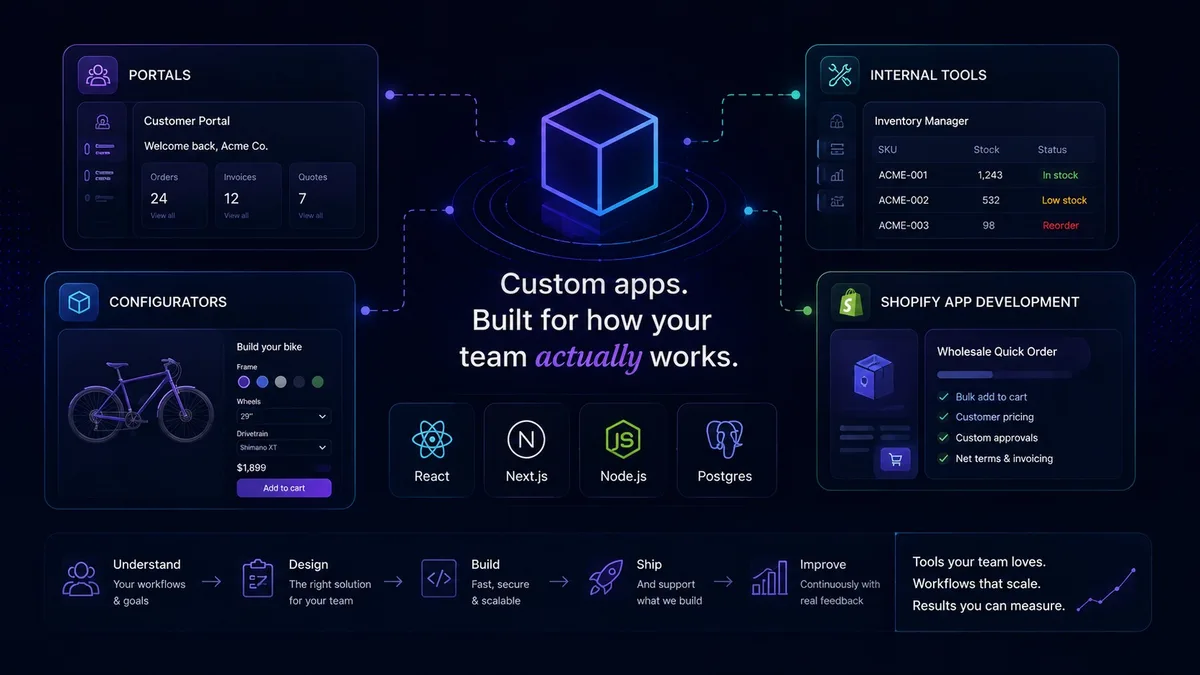
Account areas, B2B ordering, reorders, invoices, and approvals — reading from your commerce and ERP data instead of floating beside it.
Dashboards and admin panels for the workflows currently living in shared spreadsheets: purchasing, returns processing, content operations.
Configurators with real constraint logic — compatible options, price breaks, quote generation — not a chain of dropdowns pretending to be one.
The features a theme can't express: bundle builders, booking flows, calculators, metafield-driven PDP logic that changes by market.
Private apps for one store's workflow; public apps for the App Store, with OAuth, webhooks, the Billing API, and the review process handled.
The unglamorous middle: REST and GraphQL APIs, queues, scheduled jobs, and webhook handlers with retries and idempotency keys.
The same team that builds client apps builds ours. Nothing keeps estimates honest like maintaining your own production software.
Retention and loyalty tooling for commerce teams.
AI-assisted support with human handoff built in.
A configurator built around real constraint logic.
Beauty routines, shipped as a Shop Mini.
Gift finding, shipped as a Shop Mini.
React, Next.js, TypeScript. Server components where they pay for themselves, and a component system your next developer can read.
Node, Postgres, and Payload when content is involved. Boring choices on purpose — you'll still be able to hire for them in ten years.
Small team, weekly releases, two-human PR review, staging that matches production. Progress ships; it doesn't sit in a status deck.
Bring the workflow. We'll tell you if an off-the-shelf app covers it — buying is often the right answer, and it's a shorter meeting.
Scoped and quoted before a line of code. Change requests get priced, not absorbed into a drifting invoice.
Dependencies, monitoring, small features, and fixes on a monthly plan after launch. No long-term contract.
Yes, often. If an existing app covers 90% of the workflow, buy it. Custom is for the part of your process that's actually yours.
// related