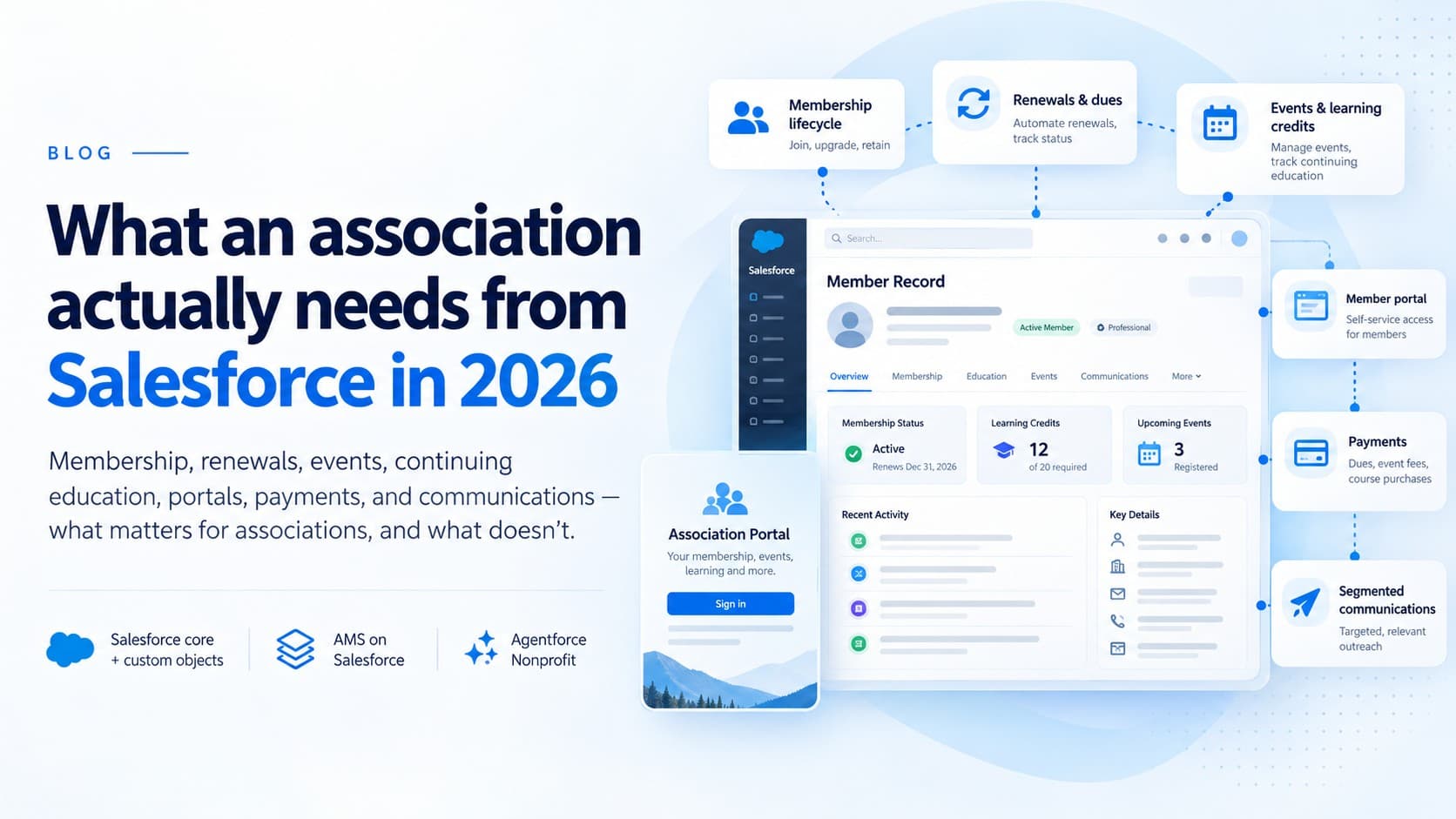
Most Salesforce advice for the non-profit world is written for charities: donors, gifts, campaigns. An association is a different animal. Its lifeblood is a membership that renews every year, dues that vary by category, events and continuing education that carry credits, and a portal where a member expects to log in once and see all of it. We're a Salesforce Partner and we built exactly that for the Chiropractic Association of Canada. This is how we'd think about it for an association starting — or restarting — in 2026.
What an association needs that a charity doesn't
- A membership lifecycle, not a donation history. Join, renew, lapse, reinstate, upgrade category — with dues rules, grace periods and provincial or chapter variations. The data model has to make “who is a member in good standing today” a one-query question.
- Events and learning with credits. Conferences, webinars and online courses that grant continuing-education credit, tracked against each member's requirements. That usually means a learning platform talking to the CRM.
- A member portal. Renew, register, download a receipt, update a licence number, see credits earned — without emailing staff. In practice this is a website, most often WordPress, with a real integration behind it, not an iframe.
- Payments in Canadian dollars, with Canadian tax handling. Dues receipts, event registrations and course fees through a Canadian processor — we've used Moneris — reconciled back to the CRM.
- Communications by segment. Members by province, category, credit status or event history, from a marketing tool that reads the CRM directly.
The Salesforce options in 2026
- NPSP (Nonprofit Success Pack). Not retired, despite what you may have heard. Salesforce says it will continue to be supported, Salesforce will take your case, and existing orgs keep running. But it has been in what Salesforce calls “End of Innovation” since March 2023: no new features, ever. It isn't a licence either — it's a set of six managed packages installed on Sales Cloud — and Salesforce no longer leads new non-profits to it. The direction is clear: the NPSP consultant certification retires on February 1, 2027. If you're on it, there's no forced migration; if you're starting fresh, don't start here.
- Agentforce Nonprofit. The current product, formerly Nonprofit Cloud, relaunched under this name in December 2025 with AI agents for things like donor support and volunteer scheduling. It's built on Salesforce's core platform rather than as a managed package, and its data model differs from NPSP's, which is why a move between them is a migration project, not an upgrade.
- An association management system on Salesforce. Products such as Fonteva and Nimble AMS package membership, dues, events and communities on top of Salesforce. They fit medium-to-large associations with the budget and staff to run them, and can be too much platform for a small one.
- Salesforce core plus custom objects. For an association whose needs are clear and specific, a lean custom data model on Sales Cloud or Agentforce Nonprofit, integrated with the portal and the learning platform, is often the least expensive to run — provided someone documents it.
The licence question most associations get wrong
Every Salesforce-for-non-profits article mentions the ten free licences. Through the Power of Us program, an eligible organization chooses ten donated Agentforce Nonprofit licences or ten Sales and Service Cloud licences. What those articles rarely say is that most associations aren't eligible. Salesforce's published eligibility guidelines exclude trade and business associations outright, and add two country rules:
- United States: only 501(c)(3) and 501(c)(4) organizations qualify. Most professional and trade associations are 501(c)(6), so they don't.
- Canada: non-profit associations, clubs and societies that aren't registered charities are excluded. A professional association incorporated as a non-profit, but not registered with the CRA as a charity, doesn't qualify.
- The exception worth checking: many associations have a charitable foundation alongside them. The foundation may qualify, but in the US the donated licences can only be used by the eligible entity, not by the association next door.
So budget for licences at commercial pricing unless you've confirmed eligibility in writing, and get the quote before anyone designs a data model. Licence cost is often what decides between Salesforce core, an AMS and a non-Salesforce platform.
What Dreamforce 2026 means for associations
Salesforce's September conference was dominated by agents: AIforce, Agentforce Coworker and a long list of new agent tooling. For non-profits specifically, partner coverage of the event reports agents previewed for Agentforce Nonprofit covering donor engagement, participant management and grantmaking, with events management and voice agents described as coming soon. Treat previews as previews: plan around what's generally available when you sign, not what was on stage.
Where an AI agent genuinely helps an association today:
- Answering “where's my receipt”, “when does my membership renew” and “how many credits do I still need” from the member's own record, at 11 p.m., without staff.
- Drafting renewal reminders and lapsed-member win-back messages by category, for a person to approve.
- Event logistics questions — schedule, location, what's included in the registration — grounded in the event record rather than a PDF.
- Summarizing a member's history before a staff member calls them back.
Where it shouldn't decide on its own: dues disputes, eligibility for a membership category, credit exemptions and anything touching discipline or licensing. And the rule every vendor repeats is true: an agent can only act on data it can see, and only as well as that data is kept. Which brings us to the unglamorous part.
What we built for the CCA
The Chiropractic Association of Canada came to us with three separate portals and staff re-keying data between them. What they have now is one platform: Salesforce with NPSP as the member system of record, Marketing Cloud for segmented communications, a WordPress member portal that reads and writes the CRM, a Learning Lab on Thinkific whose enrolments and completions flow into Salesforce, and Moneris handling payments in Canadian dollars with receipts reconciled automatically. Three portals became one login.
Two lessons from that build carry to any association. First, the learning integration matters more than people expect: Thinkific Plus has a native Salesforce connector on the AppExchange that sends enrolment, progress and completion events, but it sends new events only, so historical credits need a one-time backfill and the credit rules still live on the CRM side. Second, the portal is where members judge the whole project. The CRM can be perfect and the association still gets complaints if renewing takes four screens.
Clean the data before you move anything
Whether you're migrating, adding an AMS or switching on agents, the same five things decide how it goes:
- One membership status, with history. Not a status field plus a spreadsheet plus a tag in the email tool.
- Membership start and end dates on every record. Renewals, reporting and — for Canadian associations — email consent all depend on them.
- Duplicates merged. Members who joined with a work email and renewed with a personal one are the most common source of “I already paid” complaints.
- Continuing-education credits in one place, with where each credit came from.
- Payment references, never card numbers. The processor keeps the card; the CRM keeps the token and the receipt.
Email: CASL gives associations a head start
Canadian associations have an advantage under Canada's anti-spam law that most businesses don't. Section 10 of CASL treats membership in a club, association or voluntary organization as an existing non-business relationship, which gives implied consent to email members — and it lasts for two years, counted from the day the membership ends. A lapsed member can still get your win-back campaign for two years.
Two conditions make that usable. You need the membership end date on every record, because the burden of proving consent sits with the sender. And every message still needs your identification and a working unsubscribe. For non-members — event attendees, newsletter sign-ups, course buyers — get express consent at the point of collection and store when and how you got it. This isn't legal advice; check your own situation with counsel.
How to choose
- Confirm licence eligibility first. It changes the budget more than any feature does.
- If you're already on NPSP and it works, you have time. Plan a move on your schedule, not Salesforce's — but plan it, because the feature gap only grows.
- If you're new, start from Agentforce Nonprofit or a lean custom model. NPSP can still be installed, but starting on a product that will never get another feature only postpones the migration.
- Buy an AMS only if your membership operations are complex enough that an off-the-shelf model saves more than it constrains. Ask the vendor what a category change mid-year costs to configure.
- Decide the learning platform and the payment processor before the CRM design. Their integration constraints shape the data model.
- Budget the portal as a first-class deliverable, with its own testing, not as “the website part”.
The migration reality
There is no in-place upgrade from NPSP to Agentforce Nonprofit. You build a new org on a different data model and move into it: households, contacts, affiliations and gift or dues history mapped onto new objects, every automation and integration rebuilt rather than carried over, and staff retrained. For an association that also means re-validating membership status logic, credit calculations and portal permissions, and running the old and new systems side by side through at least one renewal cycle. It's a quarter of work done carefully, not a weekend. We'll tell you if you're not ready for it — staying on a supported NPSP for another year is a legitimate answer.
Questions to ask before you sign — including us
- Have you confirmed our licence eligibility, and what do the licences cost if we don't qualify?
- Which of the features you're showing us are generally available today?
- How will a lapsed member be identified, and who decides the grace period?
- What happens to our historical credits and receipts?
- Who owns the integrations after launch, and what does it cost when one breaks?
- Will our staff be able to change a dues rate without calling you?
See our Salesforce services, the associations & non-profits page, and the CCA case study. The portal side lives under WordPress. Or book a free consultation and bring your renewal rules.