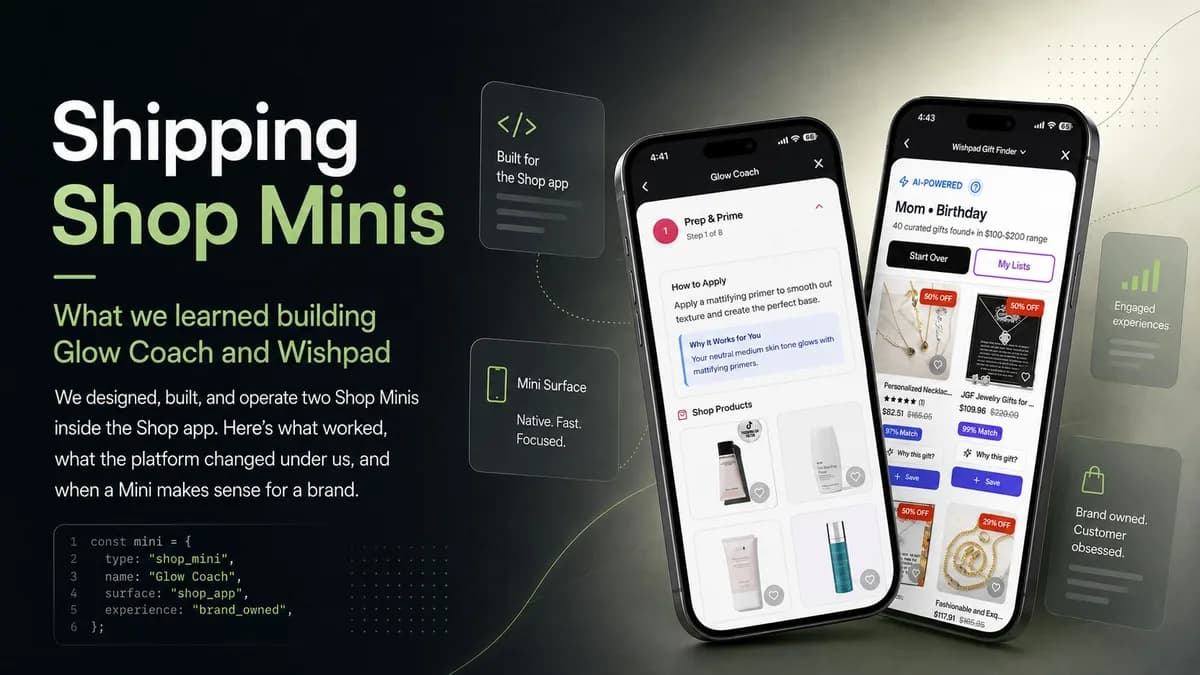
Over the past year we designed, built, and now operate two Shop Minis — Glow Coach, a daily skincare and makeup coach, and Wishpad, a guided gift finder. Minis are native mini-apps that live inside Shopify's Shop app, built with a React SDK against surfaces Shopify controls. They are one of the more interesting places to meet shoppers right now, and also one of the fastest-moving platforms we have ever shipped on. These are our honest field notes.
Why we built two very different Minis
We deliberately picked two different shapes. Glow Coach is a routine product: it gives people step-by-step makeup and skincare guidance tied to products they can buy, so the value compounds with repeat visits. Wishpad is a discovery product: a quiz-driven gift finder that turns 'who is it for, what's the occasion, what's the budget' into a short list. Building both taught us more than building two of the same thing would have — retention mechanics and discovery mechanics stress completely different parts of the platform.
The platform moved fast underneath us
If you build a Mini, expect the ground to shift. In 2026 alone:
- January brought a new Explore screen with curated categories and a Dashboard CLI for monitoring submissions and performance.
- February added a quick link to Minis from the Shop app home screen — a real visibility change — plus shoppable UGC and lower consent friction.
- March–April made optional consent the default and removed browser storage inside the Mini webview, which forced storage-pattern changes.
- May–June added typed product variant intent hooks to the React SDK and expanded the allowed dependency list.
The lesson: keep your surface area small and your update cadence high. We treat SDK updates like a monthly chore, not a quarterly project — the teams that fall three versions behind are the ones that get surprised.
What worked for us
- Designing for a borrowed surface. The Shop app has its own feel — fast, native, minimal. Minis that fight it look wrong instantly. We reused Shop's patterns and spent our design budget on the one thing per screen that mattered.
- Quiz-style onboarding. Both Minis open with a short guided flow. It doubles as personalization input and as a natural moment to explain value before asking for anything.
- Personalizing from first-party signals. Recommendations grounded in the merchant's own catalog and purchase signals beat generic suggestions — and they behave predictably in review.
- Staying inside the allowed dependency list. The SDK ships with an approved set of packages. Designing within it from day one saved us from painful rewrites later.
What we would do differently
- Plan for consent-optional from day one. We built early flows assuming consent screens; the platform then made delayed and optional consent the norm. Designing for the no-consent path first is the durable choice.
- Instrument earlier. The Dashboard CLI and submission monitoring arrived in January; before that we under-measured. Bake in event tracking from the first build.
- Scope v1 smaller. Our first Glow Coach submission did too much. The review loop rewards a focused Mini that does one thing well.
Should your brand build a Mini?
Good fits: categories with routines or replenishment (beauty, wellness, supplements), gifting and occasion-driven discovery, and brands with strong post-purchase stories. Weak fits: one-off purchases with no reason to return — a Mini nobody reopens is just an expensive checkbox.
On effort: a well-scoped Mini is weeks, not months — but budget for review iterations and for ongoing platform upkeep, because the SDK will keep moving. If you are weighing whether a Mini fits your brand, we are happy to give you a straight answer either way — including 'don't build one'.