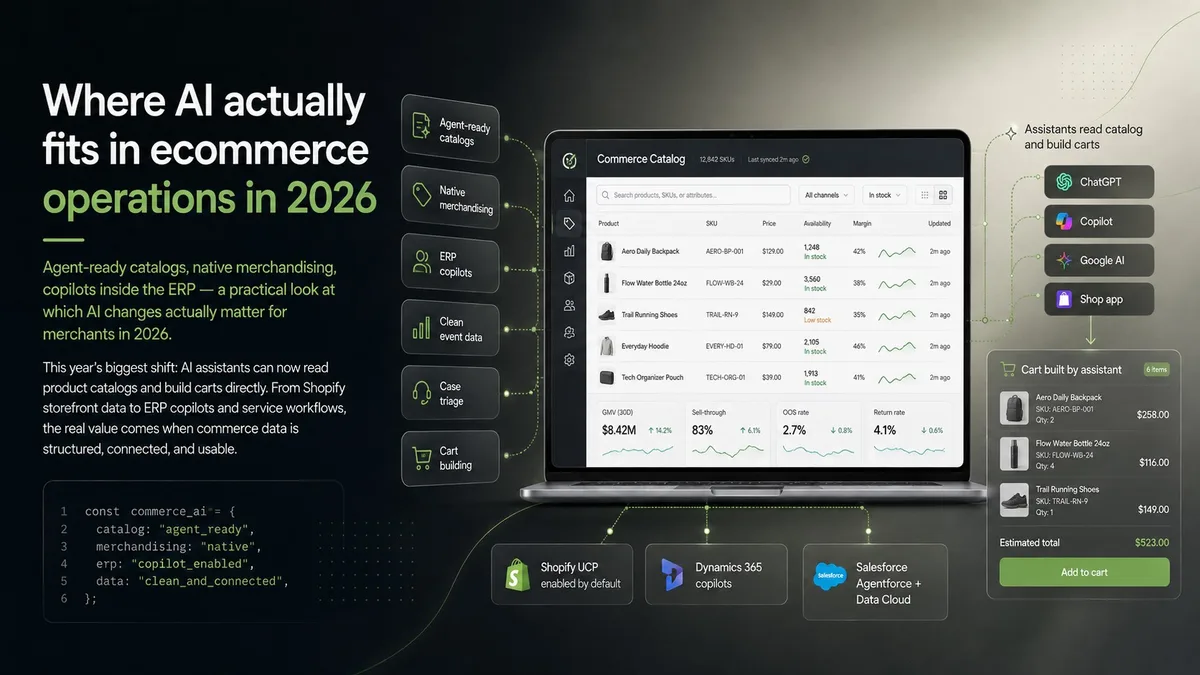
For two years, every platform keynote has promised that AI will transform commerce. Most merchants we talk to are still asking a simpler question: what should I actually do about it this quarter? We build and support stores on Shopify, business systems on Microsoft, and CRM on Salesforce — so we see which AI features get used after the demo, and which ones quietly get turned off. Here is our honest read on where things stand in 2026.
Your storefront is no longer the only front door
The biggest shift this year came in Shopify's Summer '26 Editions in June: the Universal Commerce Protocol (UCP) is now enabled by default on every Shopify store. In plain terms, AI shopping assistants can read your catalog and build carts without you lifting a finger. Eligible products can also syndicate to ChatGPT, Microsoft Copilot, Google's AI experiences, and the Shop app — which means a customer can discover and buy your product inside an assistant without ever seeing your homepage.
The practical consequence is unglamorous: product data quality is now a sales channel. Titles, descriptions, variant attributes, shipping details, and availability are what an agent 'sees'. If your feed is messy, you are invisible in the fastest-growing discovery surface there is.
What we recommend doing about it this quarter:
- Audit your product data the way an agent reads it — titles that describe the product, complete variant attributes, accurate inventory and shipping metadata.
- Fix your Google Merchant Center issues now. Disapproved products and feed errors were always a Shopping-ads problem; they are increasingly an AI-visibility problem too.
- Make sure your structured data (schema.org markup) is correct and consistent with your feed.
AI merchandising moved into the Shopify admin
Shopify also made AI merchandising native — collection sorting, cross-sell suggestions, and insights now live in the admin rather than in a third-party app. For many stores this replaces a paid app subscription with something good enough out of the box. Our advice: run it against a control collection for a few weeks and compare revenue per session before you roll it out everywhere. Native does not automatically mean better for your catalog — but it is now the sensible default to test first.
The deadline that caught stores off guard: Scripts are gone
Shopify Scripts reached a hard sunset on June 30, 2026. Scripts simply stopped executing — no storefront warning, no fallback. If your discounts, shipping logic, or payment customizations were built on Scripts and nobody migrated them to Shopify Functions, parts of your checkout are silently not doing what you think they are doing. We have migrated several stores this year; it is short, well-scoped work, and it is worth auditing even if you believe you were unaffected.
On the Microsoft side: copilots and a commerce MCP server
Microsoft's 2026 release wave pushed agent capabilities deep into Dynamics 365 — sales, service, finance, supply chain, and commerce. Two things stand out for retailers. First, Copilot Studio lets you build agents that encode your own operating rules — replenishment, allocation, fulfillment — instead of generic chat. Second, the new Dynamics 365 Commerce MCP server exposes catalog, pricing, promotions, inventory, carts, and orders as capabilities that AI agents can call. That is the plumbing that makes 'ask the system' workflows real instead of theoretical.
Our recommendation for mid-size Dynamics shops is to start with read-only copilots on data you trust: inventory questions, order status, reporting. Write-back automation comes second, after you have seen where the model misreads your business.
Salesforce: Agentforce is only as good as your data
On the Salesforce side, Agentforce keeps maturing for service and sales workflows, built on top of Data Cloud. The pattern we see: teams that invested in identity resolution and clean event data get real value — automated case triage, journey suggestions, faster follow-ups. Teams that pointed it at a messy org got confident-sounding noise. If your storefront events, CRM records, and marketing data do not agree on who the customer is, fix that before you buy anything with 'agent' in the name.
Where we would spend first
- Support triage with a human handoff — fastest payback we have seen, and the failure mode is graceful.
- Product feed and content enrichment — it compounds: better ads, better SEO, better agent visibility.
- Internal copilots for operations teams — order lookups, inventory questions, reporting drafts.
- Merchandising experiments with the native Shopify tools — cheap to test, easy to reverse.
And where we would wait: fully autonomous agents that spend money or change prices without review, and big-bang platform rewrites justified by AI alone. The winners this year are running boring, measured experiments on clean data.
AI in commerce rewards the merchants who did the unglamorous work first: clean catalogs, correct tracking, and systems that agree with each other.
If you want a second pair of eyes on any of this — an agent-readiness audit of your product data, a Scripts-to-Functions migration, or a sanity check on a copilot rollout — that is exactly the kind of scoped work we do. No big program required.