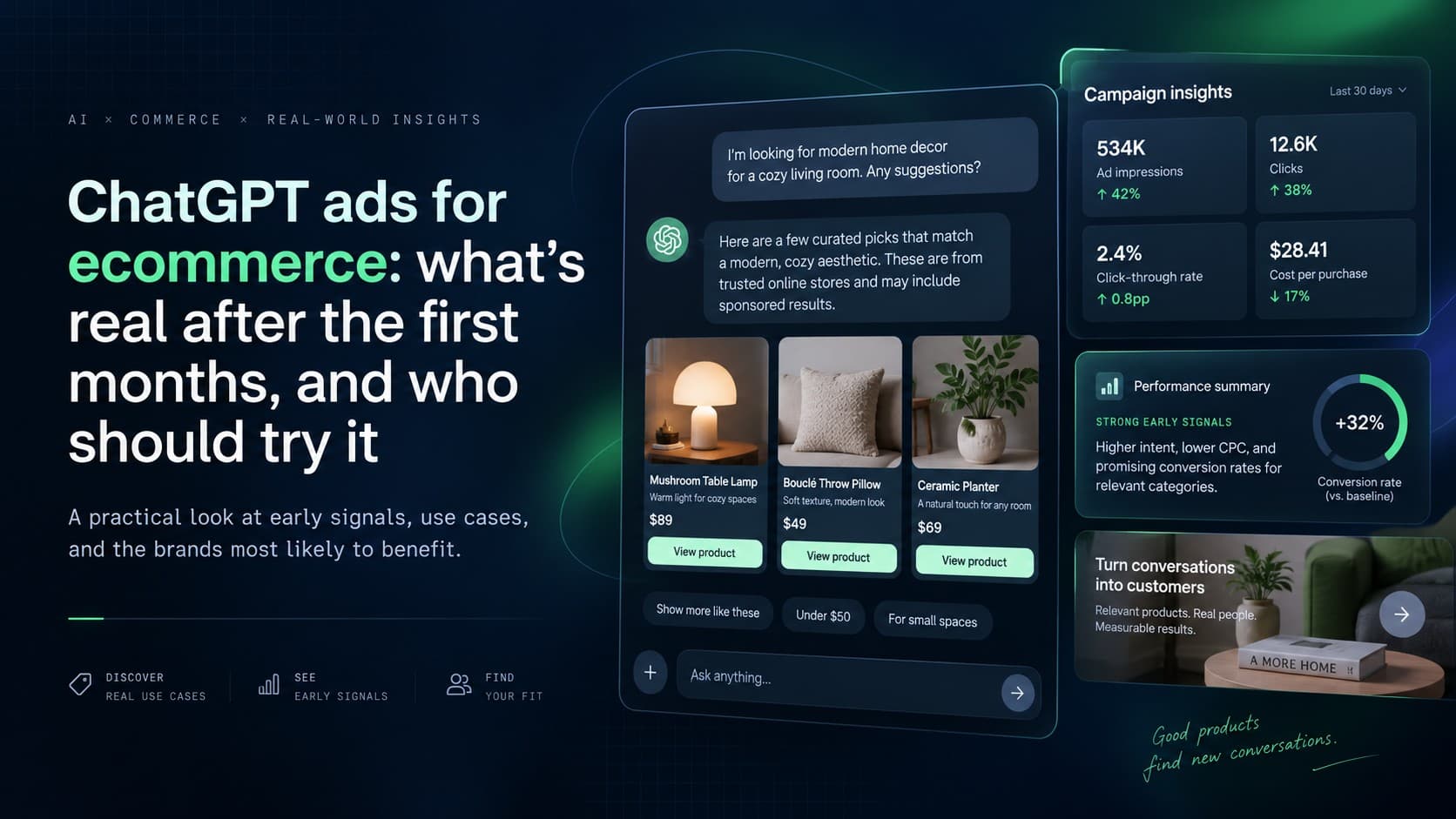
OpenAI sells ads inside ChatGPT, and the self-serve Ads Manager has gone from a US-only launch on May 5 to 52 countries as of early September — Canada, the US, the UK, 32 European markets including Norway, Australia, New Zealand, India and several Middle East and North African countries among them. There's no minimum commitment any more; the early six-figure minimums are gone. We manage it for clients alongside Google and Meta. This is what we've learned so far — written for store owners deciding whether to spend, not for people who want to be told it's the future.
How the ads actually work
- Where they appear. As clearly labelled units alongside a response, for users on ChatGPT's Free and Go tiers. Plus, Pro, Business and Enterprise users don't see ads, and accounts identified as under 18 are excluded. OpenAI's line is that ads never influence the answer itself, and that advertisers get no access to anyone's conversations.
- How they're targeted. Not by keywords. You describe the conversational themes you want to appear in — “context hints”, in plain language — plus geography, platform (iOS, Android, web) and optionally your own customer lists, uploaded hashed, with a floor of 25,000 matched users. There are no demographic segments, no lookalikes and no site retargeting. In Europe, OpenAI says ad selection uses the current conversation topic, approximate location, device, time of day and language — not chat history or memory.
- What an ad is. A business name, an image, a headline and a description, linking out. Product-feed carousel cards now exist, with reporting at the card level.
- How you pay. An auction with three objectives: reach (CPM), clicks (CPC) and, since August, conversions (oCPC, still billed per click with a cap on what you'll pay per conversion). Relevance and creative quality affect ranking, not just the bid. OpenAI has said impression-based billing optimized to your conversion goal is coming.
Two things follow from that design. First, the craft is writing for questions, not for search terms — “what should I get my dad who just started woodworking” is a context you can target; “woodworking gifts” is not a keyword you can buy. Second, because there's no organic lift from advertising (running ads doesn't make ChatGPT mention you more in unpaid answers), ads and AI-search visibility are separate efforts. Do both, but don't confuse them.
What changed since spring — and what still hasn't
Measurement grew up. There's now a browser pixel that sets a first-party cookie and hashes customer details automatically, and a server-side Conversions API that deduplicates against it by event ID — the same pattern as Meta, and the reason we insist on clean server-side tracking before anyone spends here. Reporting gained product-level fields and one-day view-through as a separate column. What hasn't changed: attribution is click-through only, there are no multi-day windows or lift studies yet, and conversions can take a day or two to appear. Judge it on the same GA4 and purchase data you judge everything else on.
Category rules matter more than on Google. Alcohol, gambling and dating are out everywhere. Outside the US, health and financial services are generally prohibited — which rules the channel out for a fair share of the wellness brands we work with, and is the first thing we check before proposing a test.
What we've seen so far — and what we haven't
We won't publish numbers from client accounts. What we can say: the channel is genuinely different from search — the intent is earlier and more exploratory, closer to a helpful shop assistant than to a Google Shopping query. Categories with a strong “help me choose” moment (gifts, hobby gear, anything with a fit or compatibility question) get more traction than commodity re-orders. And it's still early: audiences are building, benchmarks are thin, and the public tests we've read range from respectable click-through to zero conversions depending on whether the buyer actually lives on the free tier.
Who should try it now
- Stores that already have clean conversion tracking — pixel plus server-side, deduplicated — otherwise you'll be judging the channel on numbers you can't trust.
- Brands with a story that fits a conversation: a reason to be recommended, not just a price.
- Merchants with a test budget they can afford to learn with for two or three months, without starving Google or Meta.
Who should wait
- Stores whose Google Shopping and Meta programs still have obvious fixes left — feed disapprovals, broken purchase events, no CAPI. That money earns more fixing the basics.
- Very small budgets. A small budget spread over three channels teaches none of them anything.
- Categories where the buyer knows exactly what they want and just wants the cheapest one. That's still a Shopping ad's job.
- Restricted categories outside the US. Check the policy before you plan anything.
How we run a first test
- Pick two or three conversational contexts your customer service team actually hears, and write ads that answer them.
- Send traffic to pages that continue the conversation — a buying guide or a collection with the fit or compatibility question answered — not a generic homepage.
- Install the pixel and the Conversions API together, deduplicated, and confirm purchases land before the first dollar is spent.
- Track it like everything else: same conversion events, same GA4, same purchase attribution.
- Read results monthly against Google and Meta, and be willing to say “not yet” for this category.
Alongside the paid test, keep working on how assistants describe you in unpaid answers — schema, llms.txt, clear policies and structured product data. That's the part you own regardless of ad spend, and OpenAI's ad-validation crawler reads your landing pages too, so don't block it.
We manage ChatGPT ads together with Google and Meta, and we'll say plainly if your category isn't ready. See growth & ads services, read about AI search visibility, or book a free consultation. Related: is your catalog ready for AI agents?