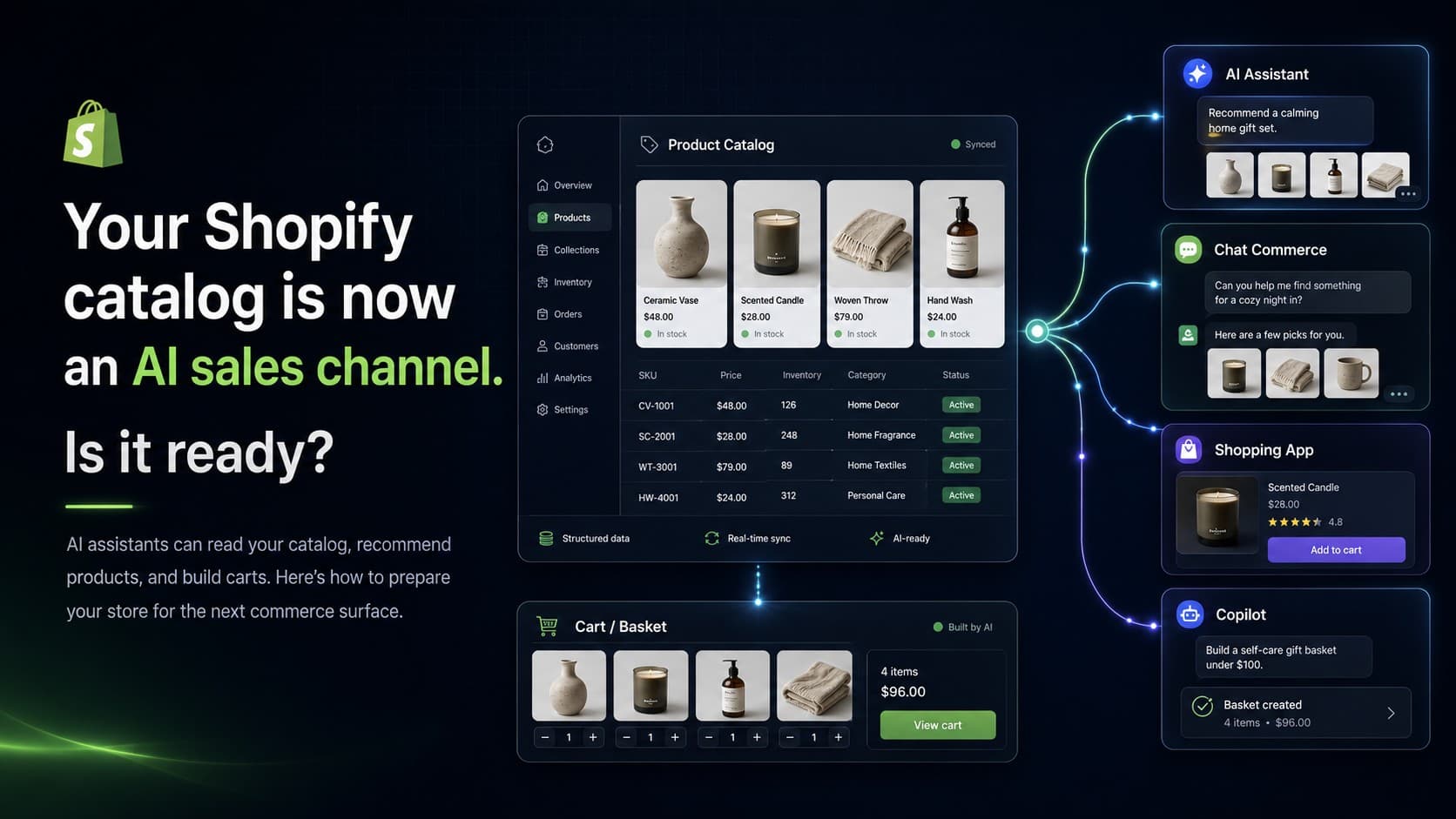
In June 2026, Shopify turned on agent visibility by default: AI shopping assistants can now discover products from Shopify stores and, through the Universal Commerce Protocol, build carts and hand off to checkout. You didn't opt in. Unless you opted out, your catalog is already being read by systems that will describe it to shoppers in their own words.
That changes what "good product data" means. A human browsing your collection page fills gaps with pictures and intuition. An agent answering "is this jacket warm enough for a Toronto winter?" only has what you wrote down. This is the checklist we run when a client asks whether they're ready.
Titles that say what the product is
Internal SKU-speak — "JKT-BLK-M-24" — is fine for your warehouse and useless to an assistant. Titles should carry brand, product type, and the one or two attributes that matter to the buyer: "Arc Down Parka — Women's, -30°C rated, Black". You don't need every attribute in the title; you need the ones someone would say out loud when asking for it.
Structured facts in metafields, not buried in prose
This is the single biggest lever. Material, fit, dimensions, compatibility, care, temperature rating, allergens, country of origin — if it lives only in a paragraph of description, an agent might find it. If it lives in a metafield with a clear definition, it will. Shopify's standard product metafield definitions (and your own custom ones) are exactly the structure agents and filters read.
A quick test: pick your top ten products and ask, for each, the three questions a customer service rep hears most. If the answer isn't a discrete field on the product, that's your backlog.
Variants that mean what they say
Size and colour as real variants, not as separate products with "— Blue" appended to the title. Consistent option names across the catalog ("Size", not "Size" here and "Sizing" there). Inventory that's actually accurate per variant, because an agent will confidently tell a shopper something is in stock if your data says so — and "continue selling when out of stock" left on by accident becomes an oversell that the assistant caused, not the customer.
Policies an agent can quote
Shipping times, return windows, and who pays return postage should be stated plainly on the shipping and returns pages and, ideally, in the product data where it varies ("final sale", "ships in 3–5 business days"). Assistants answer "can I return this?" from your policy text. Vague policies produce vague — or wrong — answers.
Channel publication is the real gate
Hiding a product from storefront search does not hide it from agents. What governs agent visibility is channel publication and the store-level agent setting. If a product genuinely shouldn't be sold through assistants — a wholesale-only SKU, a regulated item — unpublish it from the relevant channels rather than relying on theme-level hiding. We wrote up the differences between the hiding methods in an earlier post.
Images and identifiers
Every active product needs at least one clean image with descriptive alt text, and GTINs where they exist. GTINs let agents (and Merchant Center, and marketplaces) match your listing to a known product instead of guessing from the title. Missing barcodes are the most common reason a product is treated as an unknown item.
How to check whether it's working
Ask. Open the assistants your customers use — ChatGPT, Gemini, Copilot, Perplexity — and ask the questions a shopper would: "best [your category] under $X that ships to Canada", "[your brand] return policy", "does [product] come in a size 12". Note where you appear, what's said about you, and what's wrong. Repeat monthly; the platforms change fast, and this is the same measurement loop we use for our AI search visibility work.
Catalog quality used to be a merchandising nicety. In 2026 it's channel quality — the difference between being recommended and being invisible.
If you'd like a second pair of eyes on your catalog, this is the kind of audit we do — a written list of what agents can and can't read from your store, and what to fix first. Or start with a free consultation. Related reading: how to hide products from Shopify search (and what that does and doesn't hide).